Lake Bogoria
-
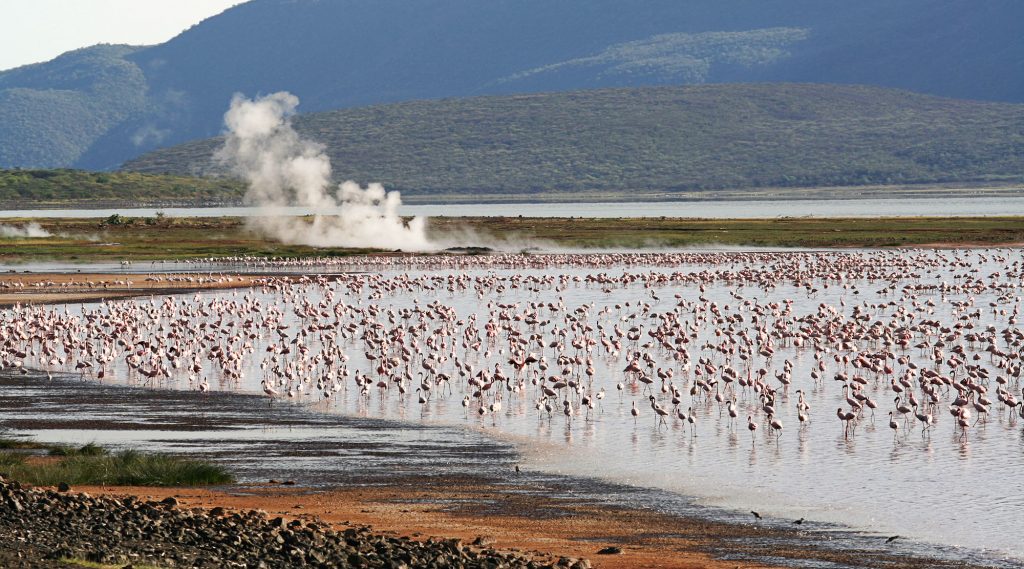
Lake Bogoria is an alkaline, salty lake located in a volcanic area in a half-graben basin just north of the equator and south of Lake Baringo, Kenya. One of the greatest concentrations of lesser flamingos in the world can occasionally be found in Lake Bogoria, Lake Nakuru, Lake Elementeita, and Lake Magadi farther south in the Rift Valley, and Lake Logipi to the north. Lake Bogoria National Reserve has been a protected national reserve since November 29, 1973, and the lake is a Ramsar site. With a drainage basin of 700 km2, Lake Bogoria is around 34 km long by 3.5 km broad and shallow (approximately 10 m depth). Baringo County is where it is situated.
The Siracho Escarpment to the east and the Kesubo Swamp to the north are examples of local characteristics that are part of the National Reserve. The lake is also well-known for its hot springs and geysers, both in the lake and along its shore. At least ten geysers that reach a height of five meters may be seen in four different places surrounding the lake. Lake level variations have an impact on geyser activity and can expose or submerge certain geysers.
Wildlife
Flamingos are fed by blue-green algae, which are fed by the alkaline lake. There may occasionally be up to two million flamingos feeding in the lake. The flamingos are preyed upon by raptors like tawny eagles. A total of 135 bird species have been identified. These include the African spoonbill, augur buzzard, gabar goshawk, water dikkop, big tit, starling, hornbill, crombec, yellow-billed stork, swift, small bee-eater, cape wigeon, pratincole, little grebe, and hornbill.
A herd of the comparatively rare Greater Kudu is present on the reserve. Buffalo, zebra, cheetah, baboon, warthog, caracal, spotted hyena, impala, and dik dik are some of the other huge animals.
Activities
- Boat excursions.
- Observing birds.
- Museum of Kabarnet.
- Riding a bicycle.